
When you live in the Kootenays, having an EV truck like the Rivian R1T is about balancing rugged capability with electric efficiency. But once the snow flies, we have to tackle the inevitable question: Where is the best place to put the ski box?
Is it better for range to mount the box low, over the bed, or stick with the traditional roof mount? My gut told me low was better, but I prefer data. I ran some controlled uphill and downhill tests last winter to find out if there is a measurable difference.
The Testing
To simulate real-world driving conditions, I took the R1T to my usual efficiency testing zone (a consistent stretch of local road – see the previous post for more details) on a day with damp roads, -3C, and tested at 100 km/h. I tested three configurations:
- Bare Roof: Our baseline consumption (no rack, no box).
- Box Over Bed (BOB): Ski box mounted low over the truck bed, sitting just above the closed tonneau cover.
- Box On Roof: Ski box mounted high on the truck roof.
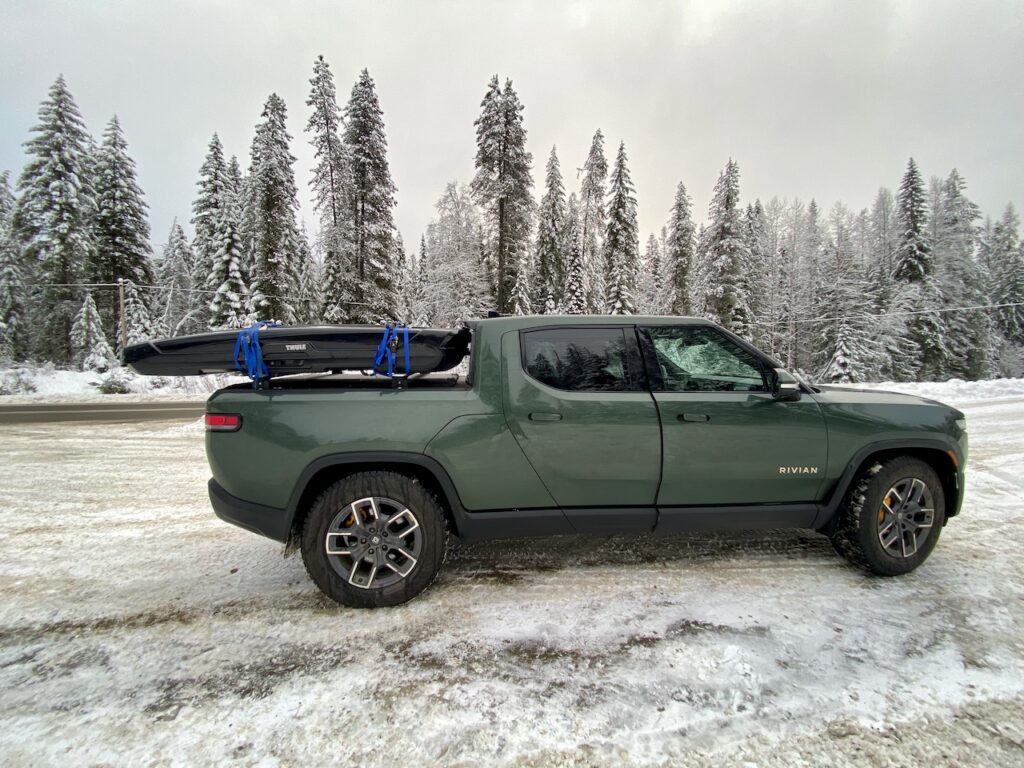
The results, measured in Wh/km (Watt-hours per kilometer), are conclusive.
| Setup | Downhill Efficiency (Wh/km) | Uphill Efficiency (Wh/km) | Blended Average (Wh/km) | % Increase over Bare Roof |
|---|---|---|---|---|
| Bare Roof | 219 | 424 | 322.5 | — |
| Box Over Bed | 232 | 430 | 331.5 | +3% |
| Box On Roof | 240 | 446 | 343.5 | +6.5% |
Data Analysis: The Aerodynamic Truth
The numbers don’t lie. Moving the box from the roof to the over the bed area yields a measurable aerodynamic advantage.
- The traditional Box On Roof increased average consumption by 6.5%.
- Mounting the Box Over Bed effectively cut that penalty in half, resulting in an overall increase of just 3% over the bare truck.
This result is in-line with that found in a separate modelling analysis for a sedan with roof box vs sedan with rear-storage box. The R1T is a very aerodynamic design (for a truck at 0.30 Cd claimed – here is a video of a 3rd party that modelled it to corroborate). After this test, I did end up figuring out a way to mount the ski box over the bed (I had to modify the box and obtain new mounting hardware). I think the hit to efficiency would be even less if I centre-mounted the ski box (see the “flow lines” about 9:10 in the video – Rivian designed the air flow to re-attach behind the cab to the tailgate, and the “flow lines” converge – ideally the box would be within the red area entirely), but to maximize accessibility I kept it close to the side of the truck.
Practical Takeaways: Saving Time and Money
What does a 3.5% improvement look like on a real ski trip? I ran the numbers for our recent 1,100km round trip to Silverstar, where our truck averaged around 345 Wh/km (2.9 km/kWh) and consumed 380 kWh total with the box mounted on the roof:
- Box Over Bed (333 Wh/km): I would have saved about 14 kWh of energy. When fast-charging, this translates to a savings of $5 to nearly $9 depending on local charging costs and several minutes of total charging time over the course of the trip.
- No Box (324 Wh/km): If you don’t need a ski box at all, you would use about 24 kWh less energy.
Over the course of a winter I typically drive about 15,000 km with a ski box on the truck. Switching from the roof to over the bed will save about 180 kWh ($24 with my home charging rate). The hardware cost me about $50, so two winters will pay it off 😉

Beyond efficiency: Real-World Usability
Efficiency is only one part of the equation, especially when we consider the everyday utility of the R1T:
- Noise Level: The difference is night and day. The BOB setup is noticeably quieter—barely louder than driving with no box at all. This alone is a huge quality-of-life win for long hauls.
- Access Height: Getting heavy skis in and out of the BOB setup is far more comfortable and accessible than reaching up to the roof. It also saves me having to either stand in the rear door area or on the Gear Tunnel door.
- The Tonneau Problem: A minor drawback specific to my configuration: having the crossbars mounted over the tonneau prevents my aftermarket tonneau from rolling up on itself, and thus from opening. If you have the built-in tonneau from Rivian, this would not be an issue.
- Visibility & Safety: The box, when mounted low over the tonneau, sticks out about 1.5 feet past the bumper and is completely invisible in the regular back-up camera view. You need to be careful not to crunch it while maneuvering in tight spots.
Conclusion
For our first winter with the truck, we left the ski box on the roof the whole time. After completing this testing last December, we moved the ski box to be over the bed. I don’t love the way it looks, but reducing wind noise and improving access were significant everyday wins. The fact that it will save me a few $ in the long run is a bonus.
Here’s a short video related to this blog post on my YouTube channel.
Side note: if your skis are about 178cm or shorter, you don’t need a ski box at all, so this blog post might not apply to your situation. Our skinny skis are quite long (up to 205cm) and I run my DH skis a bit long too (up to 184cm), so to avoid the skis sticking diagonally out the top of the box, we usually have the ski box mounted.

.jpg)
He is very passionate about the future of energy generation & usage. He prefers bikes & buses to cars, but acknowledges that Canadian cities have been developed primarily with cars in mind, so if we're going to drive, let's make them all EVs!
- R1T Efficiency Tests: Ski box on the roof or over the bed? - December 14, 2025
- R1T Efficiency Tests: Bikes and Ski Boxes - March 30, 2024
- Adding Outdoor Accessories to my R1T - December 1, 2023
